
Solid Tumor NGS Genetic Profiling Tests
With our Oncopedia and Cerebropedia panels, we provide targeted genetic mutation, fusion, and biomarker analysis from tissue samples in lung cancer and central nervous system tumors (gliomas) using the Next Generation Sequencing (NGS) method.
Explore Test PanelsSolid Tumor Profiling Tests
Comprehensive molecular mapping is performed from paraffin section samples of solid tumors using Next Generation Sequencing (NGS) technology. Thus, the genetic profile of the tumor is determined, and targeted smart drugs, current treatment guidelines (NCCN, ESMO), and suitable clinical trials are reported.
Oncopedia
It provides comprehensive genetic mutation analysis on paraffin sections in lung cancer and other solid tumors. In addition to specific mutations, it determines suitability for FDA and EMA-approved treatments by including Tumor Mutational Burden (TMB), Microsatellite Instability (MSI), and Genomic Instability Metric (GIM) analyses.
Cerebropedia
It provides molecular examination specific to central nervous system tumors such as glioma, glioneuronal, and neuronal tumors. By detecting IDH1, ATRX, TP53 mutations and various gene fusions, it contributes to diagnostic classification, prognostic evaluation, and planning of clinical trials.
Review Our NGS Clinical Reports
You can preview our international report standards prepared in accordance with FDA, EMA, and NCCN guidelines directly on the page. Click on the report images to enlarge.
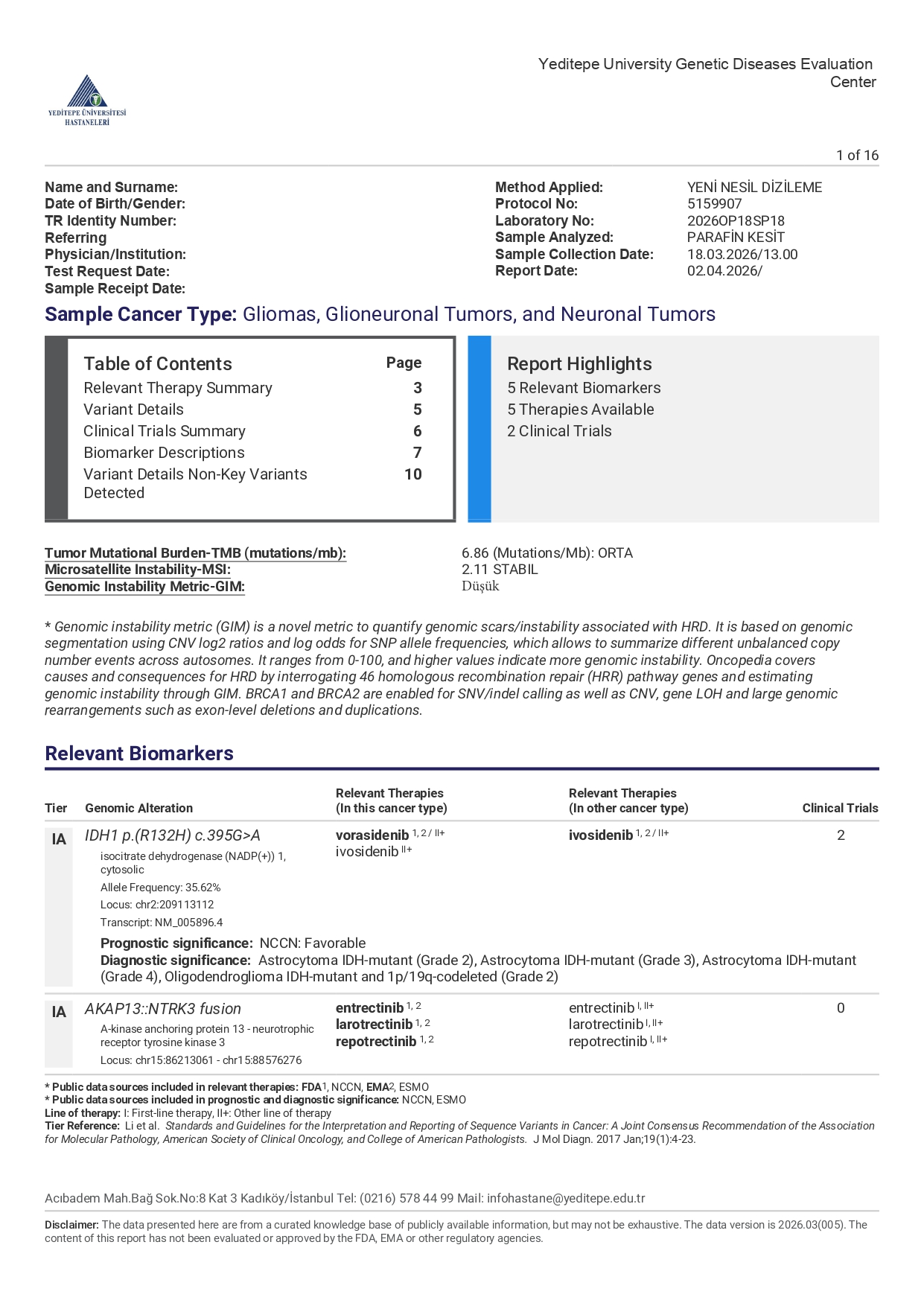
Oncopedia Report
Comprehensive Solid Tumor Panel Preview
Cerebropedia Report
Neuro-Oncology Panel Preview
Our Step-by-Step NGS Test Process
Our fast and reliable genetic analysis workflow at international standards.
1. Sample Acceptance
Paraffin tissue sections (FFPE) for solid tumors or bone marrow samples for myeloid tests are securely delivered to our laboratory.
2. NGS Sequencing
Mutations in the DNA/RNA structure of the tumor are screened using high-precision Next Generation Sequencing (NGS) technology.
3. Bioinformatics Analysis
Millions of genetic data are analyzed to detect gene mutations, fusions, and copy number variations (CNVs).
4. Clinical Reporting
A detailed report containing targeted smart drug and clinical trial matchings based on FDA, EMA, NCCN, and ESMO guidelines is presented to your physician.
Consult Us for Our Solid Tumor Tests
Get detailed information from our expert team about Oncopedia and Cerebropedia genetic profiling processes, FFPE tissue sample acceptance conditions, or targeted therapy reporting.
Why Should You Have a Solid Tumor NGS Test?
Profiling the genetic makeup of the tumor plays a critical role in determining targeted therapies.
Targeted Smart Drugs
It helps reduce the side effects of chemotherapy by enabling the identification of smart drugs that exclusively target the tumor cell.
Time and Cost Savings
Instead of analyzing genes one by one, hundreds of genetic changes are examined simultaneously in a single test with NGS sequencing.
Immunotherapy Suitability
The efficacy of immunotherapy treatment is evaluated through Tumor Mutational Burden (TMB) and Microsatellite Instability (MSI) analyses.
Current Guidelines Support
Approved drugs and clinical trials are reported based on international guidelines such as FDA, EMA, NCCN, and ESMO.
Analysis at International Standards with Oncomine™ Comprehensive Assay Plus
The advanced Next Generation Sequencing (NGS) panel used in our laboratory detects all critical genetic changes and immunotherapy biomarkers in solid tumors with high precision in a single test.
517 Genes & DNA/RNA Sequencing
By simultaneously performing DNA and RNA analysis, 517 genes associated with solid tumors are comprehensively screened. Maximum accuracy is ensured in fusion detection with RNA sequencing.
All Variant Types
Single Nucleotide Variants (SNV), Insertions/Deletions (Indel), Copy Number Variations (CNV), and over 1,300 gene fusion isoforms are detected in a single analysis.
TMB, MSI, and HRD (GIM)
Tumor Mutational Burden (TMB) and Microsatellite Instability (MSI), which predict immunotherapy response, and Genomic Instability Metric (GIM) for PARP inhibitors are scored.
Success with Limited FFPE Tissue
Highly successful results are achieved with low nucleic acid input, even in small needle biopsy samples that are formalin-fixed and paraffin-embedded (FFPE).
Analyzed Cancer Types and Tumor Groups
The Oncopedia and Cerebropedia panels provide a genetic profile that guides treatment in various solid tumor types.
Lung Cancers
Detailed analysis of mutations such as KRAS, EGFR, ALK, and ROS1, which are targets for smart drugs.
Brain Tumors (Gliomas)
Detection of IDH1, ATRX, TP53 mutations and gene fusions with the Cerebropedia panel.
Colorectal Cancers
Targeted drug guidance with KRAS, NRAS, BRAF mutations and MSI instability.
Other Solid Tumors
Genetic profiling of pancreatic, ovarian, breast, melanoma, and rare solid tumors.
Frequently Asked Questions About Solid Tumor NGS Tests
All the details you wonder about Oncopedia and Cerebropedia genetic profiling tests, tissue sample requirements, smart drug matching, and reporting processes.
Get Information for Personalized Oncology Treatment
You can contact our expert team immediately regarding Oncopedia and Cerebropedia tests, sample acceptance conditions, or reporting processes.